
- Home
- Courses
- Scholarship
- Placements
- Blog
- From Gamer to Game Creator: How to Start Your Career in Game Design
- AD3D Edge Plus Course at MAAC Dilsukhnagar – A Complete Guide
- AI vs Graphic Designers: Why Creative Skills Still Matter in the Digital Era
- Top Reasons to Choose a VFX Course at MAAC Dilshukhnagar
- Top Programs to Launch Your Career in VFX and Filmmaking
- How OTT Platforms Are Creating Demand for Animation & Filmmaking
- Love Playing Games? Discover How You Can Create Them
- Want to Create the Next GTA or PUBG? Start Your Journey with Game Design
- Building Digital Dreams: Exploring Career Opportunities in 3D Animation
- Top Reasons to Choose a VFX Course at MAAC Dilshukhnagar
- Top Programs to Launch Your Career in VFX and Filmmaking
- How OTT Platforms Are Creating Demand for Animation & Filmmaking
- Top 5 Software Tools Every Motion Graphics Designer Should Learn
- Is ADVFX Plus the Right VFX Course for You? Here’s What We Think
- Becoming a Pro Animator: Key Software Skills You’ll Learn at Hyderabad’s Top Institute
- The Game-Changing Future of Content Creation: AI, Automation & Human Creativity
- From Canva to Cinema: How Graphic Design is Evolving in the AI Era
- Career Opportunities After a 3D Animation Course Explained
- Design the Next Big Game: Unlock Your Creativity Journey Today
- Behind Every Blockbuster: The Power of Visual Effects Careers
- Contact Us
- About Us
From Gamer to Game Creator: How to Start Your Career in Game Design
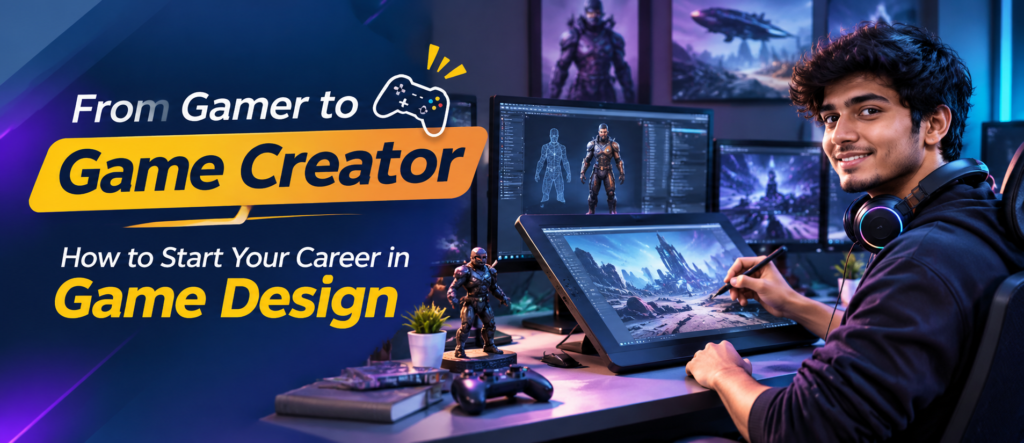
Have you ever played a video game and wondered how its characters, environments, animations, and exciting challenges were created? From realistic open-world adventures to action-packed mobile games, every gaming experience begins with creative ideas and technical expertise.
Today, gaming is more than entertainment. It is a creative industry offering career opportunities in game design, 3D modelling, animation, visual effects, and interactive development.
If you enjoy playing video games and dream of creating your own, enrolling in a Game Design Course in Hyderabad can be an exciting first step toward building your career.
Let’s explore how you can transform your passion for gaming into professional game design skills.
What Is Game Design?
Game design is the creative process of developing the concepts, rules, characters, environments, challenges, and interactive experiences that make video games engaging.
Game designers work closely with artists, animators, programmers, and developers to transform ideas into playable experiences.
While game development focuses on the technical implementation of games, game design emphasizes gameplay mechanics, storytelling, user experience, and player engagement.
Students pursuing Game Design Courses in Hyderabad can learn how creativity and technology work together to produce interactive digital experiences.
Why Choose Game Design as a Career?
The gaming industry continues to evolve with advancements in artificial intelligence, real-time rendering, virtual reality, and interactive entertainment.
Modern games require professionals with diverse creative and technical abilities.
Here are some reasons to consider a career in game design:
- Creative Opportunities: Design characters, environments, levels, and interactive experiences.
- Technology Exposure: Work with industry-relevant tools and game engines.
- Multiple Career Paths: Explore game art, animation, level design, and development.
- Portfolio Development: Showcase your skills through practical projects.
- Continuous Learning: Develop expertise as gaming technologies evolve.
Students searching for the Best Game Design Institute in Hyderabad should prioritize practical training, updated software knowledge, and opportunities to develop professional portfolios.
Step 1: Understand the Game Development Process
Before creating a game, it is important to understand how games are developed.
A typical game development process includes:
Concept Development: Creating the central idea, storyline, objectives, and gameplay mechanics.
Character Design: Developing the appearance and personality of game characters.
Environment Design: Building interactive worlds, landscapes, and virtual settings.
3D Modelling: Creating digital objects, characters, vehicles, and other game assets.
Animation: Adding realistic movements and actions to characters and objects.
Game Programming: Implementing gameplay systems and interactions.
Testing: Identifying technical issues and improving the player experience.
A professional Game Development Course in Hyderabad can introduce students to these stages through structured learning and practical assignments.
Step 2: Learn Essential Game Design Skills
Successful game creators combine imagination with technical knowledge.
3D Modelling and Texturing
3D modelling involves creating digital characters, objects, and environments. Texturing adds surface details, colours, and materials to make these models visually appealing.
Students exploring 3D Game Art Courses in Hyderabad can develop skills in modelling, texturing, and digital asset creation.
Game Animation
Animation brings characters and objects to life through movement.
Learning animation principles helps students create walking cycles, character actions, and interactive sequences.
Level Design
Level designers develop the environments and challenges players experience throughout a game.
They consider gameplay flow, difficulty, navigation, and player engagement.
Game UI and UX Design
Game user interface design focuses on menus, buttons, health indicators, and other visual elements.
User experience design ensures these interactions remain understandable and enjoyable.
Creative Problem-Solving
Game designers must continuously test ideas, identify challenges, and improve gameplay experiences.
Developing these skills helps students prepare for different roles within the gaming industry.
Step 3: Learn Industry-Relevant Game Development Software
Modern game creation involves specialized software for designing, animating, and developing interactive experiences.
Two widely used game engines are Unity and Unreal Engine.
Unity
Unity supports the development of interactive games and applications across multiple platforms.
It is commonly used for mobile games, independent projects, and interactive experiences.
Unreal Engine
Unreal Engine is known for advanced real-time rendering, detailed environments, and high-quality visual experiences.
Students interested in an Unreal Engine Course in Hyderabad can explore real-time game environments, lighting, materials, and interactive development.
Learning these tools can help aspiring game creators understand how digital assets become playable experiences.
Step 4: Build a Strong Game Design Portfolio
A portfolio is one of the most important assets for aspiring game designers.
It demonstrates your creativity, technical abilities, and understanding of game development workflows.
Your portfolio can include:
- Original game character designs
- 3D models and textured assets
- Interactive game environments
- Level design projects
- Character animations
- Game UI concepts
- Small playable game prototypes
Students pursuing Game Design Training in Hyderabad should focus on completing practical projects rather than relying only on theoretical knowledge.
A well-organized portfolio can help demonstrate your abilities when applying for internships and entry-level opportunities.
Step 5: Explore Career Opportunities in Game Design
Completing relevant training can prepare students to explore several creative and technical roles.
Popular Career Opportunities in Game Design include:
Game Designer: Develops gameplay concepts, mechanics, and player experiences.
3D Game Artist: Creates characters, props, and environmental assets.
Level Designer: Builds playable environments and interactive challenges.
Game Animator: Develops movements and animations for game characters.
Game UI Designer: Designs interfaces and visual elements for interactive games.
Game Developer: Uses programming and game engines to implement gameplay features.
Environment Artist: Creates detailed virtual worlds and game environments.
Entry-level opportunities depend on individual skills, portfolio quality, technical knowledge, and employer requirements.
Step 6: Choose the Right Game Design Institute
Selecting the right training institute is an important step in your learning journey.
Students searching for Game Design Courses After 12th should evaluate institutes based on curriculum, faculty experience, practical training, software exposure, and career guidance.
Before enrolling, consider these questions:
- Does the course cover both creative and technical concepts?
- Will students work on practical projects?
- Are Unity and Unreal Engine included in the curriculum?
- Does the institute provide portfolio development guidance?
- What placement assistance and career support are available?
Choosing a structured learning programme can help beginners develop their skills progressively.
Why Choose MAAC Dilsukhnagar for Game Design Training?
For students interested in learning game design and development, MAAC Dilsukhnagar is an institute worth exploring.
MAAC Dilsukhnagar offers the ADIDG Plus (Advanced Program in Interactive Design and Games) programme, which introduces students to important aspects of interactive design and game creation.
The programme covers areas such as game art and design fundamentals, game UI, 3D modelling, texturing, lighting, and game development using Unity and Unreal Engine.
With a curriculum spanning approximately 602 hours over about two years, the programme provides structured learning for aspiring game creators.
Students looking for a Game Design Course in Dilsukhnagar or Game Development Training in Hyderabad can explore MAAC Dilsukhnagar’s curriculum and available learning opportunities.
Prospective students should confirm current course duration, fees, software modules, eligibility, and placement assistance directly with the institute.
Conclusion: Turn Your Gaming Passion into Creative Skills
Every successful game begins with an idea, but transforming that idea into an interactive experience requires creativity, technical knowledge, and consistent practice.
Whether you dream of designing characters, developing immersive environments, creating animations, or building playable games, game design offers several exciting career possibilities.
By learning relevant software, completing practical projects, and developing a strong portfolio, you can take meaningful steps toward entering the gaming industry.
If you are searching for a Game Design and Development Course in Hyderabad, consider exploring the training programmes at MAAC Dilsukhnagar.
Stop Just Playing Games. Start Creating Them!
Begin your game design learning journey with MAAC Dilsukhnagar and take the first step toward turning your creativity into a career.