- Home
- About Us
- courses
- Blog
- AI vs Graphic Designers: Why Creative Skills Still Matter in the Digital Era
- Top Reasons to Choose a VFX Course at MAAC Dilshukhnagar
- Top Programs to Launch Your Career in VFX and Filmmaking
- How OTT Platforms Are Creating Demand for Animation & Filmmaking
- Love Playing Games? Discover How You Can Create Them
- Want to Create the Next GTA or PUBG? Start Your Journey with Game Design
- Building Digital Dreams: Exploring Career Opportunities in 3D Animation
- Top Reasons to Choose a VFX Course at MAAC Dilshukhnagar
- Top Programs to Launch Your Career in VFX and Filmmaking
- How OTT Platforms Are Creating Demand for Animation & Filmmaking
- Top 5 Software Tools Every Motion Graphics Designer Should Learn
- Is ADVFX Plus the Right VFX Course for You? Here’s What We Think
- Becoming a Pro Animator: Key Software Skills You’ll Learn at Hyderabad’s Top Institute
- The Game-Changing Future of Content Creation: AI, Automation & Human Creativity
- From Canva to Cinema: How Graphic Design is Evolving in the AI Era
- Career Opportunities After a 3D Animation Course Explained
- Design the Next Big Game: Unlock Your Creativity Journey Today
- Behind Every Blockbuster: The Power of Visual Effects Careers
- Bring Your Imagination to Life with Industry-Ready Animation Skills
- Building Digital Dreams: Exploring Career Opportunities in 3D Animation
- Want to Create the Next GTA or PUBG? Start Your Journey with Game Design
- Love Playing Games? Discover How You Can Create Them
- Top Reasons to Choose a VFX Course at MAAC Dilshukhnagar
- Top Programs to Launch Your Career in VFX and Filmmaking
- How OTT Platforms Are Creating Demand for Animation & Filmmaking
- Top 5 Software Tools Every Motion Graphics Designer Should Learn
- Is ADVFX Plus the Right VFX Course for You? Here’s What We Think
- Becoming a Pro Animator: Key Software Skills You’ll Learn at Hyderabad’s Top Institute
- The Game-Changing Future of Content Creation: AI, Automation & Human Creativity
- From Canva to Cinema: How Graphic Design is Evolving in the AI Era
- Career Opportunities After a 3D Animation Course Explained
- Design the Next Big Game: Unlock Your Creativity Journey Today
- Is Graphic Design a Good Career Choice in 2026? Skills, Jobs & Future Opportunities
- Behind Every Blockbuster: The Power of Visual Effects Careers
- Contact Us
- Faq
- Placements
- Home
- About Us
- courses
- Blog
- AI vs Graphic Designers: Why Creative Skills Still Matter in the Digital Era
- Top Reasons to Choose a VFX Course at MAAC Dilshukhnagar
- Top Programs to Launch Your Career in VFX and Filmmaking
- How OTT Platforms Are Creating Demand for Animation & Filmmaking
- Love Playing Games? Discover How You Can Create Them
- Want to Create the Next GTA or PUBG? Start Your Journey with Game Design
- Building Digital Dreams: Exploring Career Opportunities in 3D Animation
- Top Reasons to Choose a VFX Course at MAAC Dilshukhnagar
- Top Programs to Launch Your Career in VFX and Filmmaking
- How OTT Platforms Are Creating Demand for Animation & Filmmaking
- Top 5 Software Tools Every Motion Graphics Designer Should Learn
- Is ADVFX Plus the Right VFX Course for You? Here’s What We Think
- Becoming a Pro Animator: Key Software Skills You’ll Learn at Hyderabad’s Top Institute
- The Game-Changing Future of Content Creation: AI, Automation & Human Creativity
- From Canva to Cinema: How Graphic Design is Evolving in the AI Era
- Career Opportunities After a 3D Animation Course Explained
- Design the Next Big Game: Unlock Your Creativity Journey Today
- Behind Every Blockbuster: The Power of Visual Effects Careers
- Bring Your Imagination to Life with Industry-Ready Animation Skills
- Building Digital Dreams: Exploring Career Opportunities in 3D Animation
- Want to Create the Next GTA or PUBG? Start Your Journey with Game Design
- Love Playing Games? Discover How You Can Create Them
- Top Reasons to Choose a VFX Course at MAAC Dilshukhnagar
- Top Programs to Launch Your Career in VFX and Filmmaking
- How OTT Platforms Are Creating Demand for Animation & Filmmaking
- Top 5 Software Tools Every Motion Graphics Designer Should Learn
- Is ADVFX Plus the Right VFX Course for You? Here’s What We Think
- Becoming a Pro Animator: Key Software Skills You’ll Learn at Hyderabad’s Top Institute
- The Game-Changing Future of Content Creation: AI, Automation & Human Creativity
- From Canva to Cinema: How Graphic Design is Evolving in the AI Era
- Career Opportunities After a 3D Animation Course Explained
- Design the Next Big Game: Unlock Your Creativity Journey Today
- Is Graphic Design a Good Career Choice in 2026? Skills, Jobs & Future Opportunities
- Behind Every Blockbuster: The Power of Visual Effects Careers
- Contact Us
- Faq
- Placements
How Long Does It Take to Learn Video Editing Professionally?
Video has become one of the most powerful forms of digital communication. From Instagram Reels and YouTube videos to advertisements, films, corporate content and OTT productions, almost every industry needs skilled video editors. As a result, many students and aspiring creators are searching for a Video Editing Course in Hyderabad to turn their creative interests into professional skills.
One of the most common questions beginners ask is: How long does it actually take to learn video editing professionally?
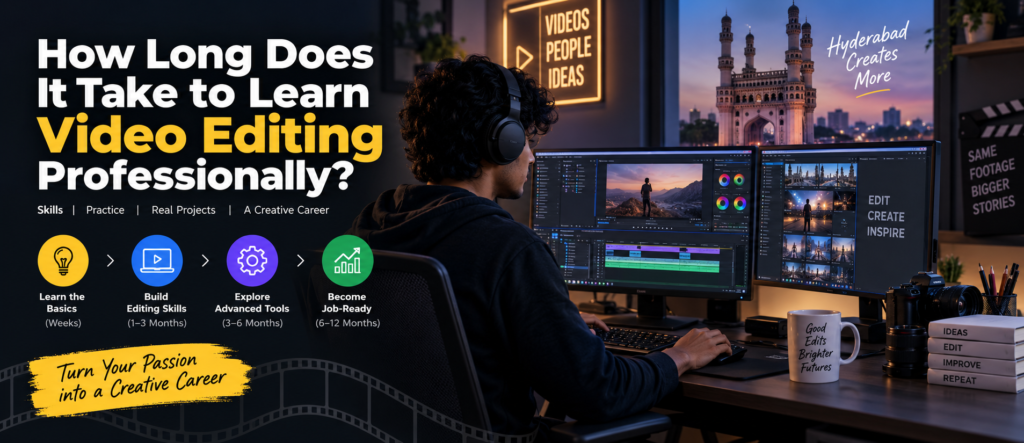
There is no single timeline that works for everyone. Learning basic editing can take a few weeks, while developing professional-level editing, storytelling and post-production skills generally requires several months of consistent learning and practical experience. Let’s understand the journey in detail.
Can You Learn Video Editing in a Few Weeks?
Yes, you can learn the basics of video editing relatively quickly. Within the first few weeks, beginners can understand how editing software works and start creating simple videos.
At this stage, students generally learn how to import and organize footage, work with timelines, trim clips, create basic cuts, add music and sound, insert titles and graphics, use simple transitions and export videos in different formats.
This foundation is enough to start experimenting with short videos, social media content and personal projects. However, knowing how to operate editing software does not automatically make someone a professional video editor.
Students joining a Video Editing Training Institute in Hyderabad should focus on developing both technical skills and creative decision-making.
1–3 Months: Building Strong Editing Fundamentals
After learning the interface and basic tools, the next stage is understanding why and where to make an edit.
Professional editing is closely connected to storytelling. Editors need to understand pacing, continuity, audience attention and emotion.
During the first few months of a Professional Video Editing Course, students may begin exploring techniques such as J-cuts, L-cuts, match cuts, jump cuts, multicamera editing, speed adjustments, audio synchronization and basic colour correction.
Instead of simply placing clips together, students begin thinking about how every cut contributes to the story.
This is also the stage where consistent practice becomes extremely important. Editing different types of footage helps students understand how techniques change depending on the project.
3–6 Months: Moving Towards Professional Editing
With regular training and hands-on projects, students can gradually move towards more advanced post-production skills.
A structured Video Editing Course with Practical Training can introduce students to areas such as advanced editing techniques, sound design, colour grading, motion graphics, visual effects integration and professional workflow management.
Students may also work with industry-standard software depending on their curriculum. Learning tools such as Adobe Premiere Pro and After Effects can help aspiring editors understand both editing and motion-based post-production workflows.
Those searching for an Adobe Premiere Pro Course in Hyderabad should remember that software knowledge is only one part of professional editing. Understanding storytelling, timing and visual communication is equally important.
6–12 Months: Developing Professional-Level Skills
For many learners, six months to a year of structured learning and consistent practice can create a strong foundation for professional work. The exact timeline depends heavily on the course, individual practice, project complexity and the student’s learning pace.
At this stage, students should be comfortable handling larger projects and solving common post-production challenges independently.
They may work on projects such as advertisements, short films, interviews, YouTube videos, Instagram content, corporate videos and promotional campaigns.
A good Video Editing Certification Course in Hyderabad should ideally give students opportunities to work on different content formats rather than practising only individual software tools.
Working across different formats helps students understand how editing styles change according to platform, audience and purpose.
Learning Video Editing Is More Than Learning Software
One of the biggest misconceptions among beginners is that mastering software automatically makes someone a professional editor.
Software provides the tools. The editor provides the creative decisions.
A skilled editor understands when a scene should breathe, when a cut should happen, how music changes emotion and how visual rhythm keeps audiences engaged.
That is why students looking for the Best Video Editing Course in Hyderabad should consider a curriculum that combines software training with practical projects and creative fundamentals.
Skills such as storytelling, sound design, colour theory, composition and motion graphics can make a significant difference to the final output.
How Important Is Motion Graphics?
Modern editors are increasingly expected to understand more than traditional cutting and trimming.
Brands, agencies and content creators frequently use animated titles, typography, logo animations, social media graphics and other motion elements.
A Motion Graphics and Video Editing Course in Hyderabad can therefore be useful for students who want to develop a broader post-production skill set.
Similarly, learning After Effects can help editors understand animation, compositing and motion graphics. Students searching for an After Effects Course in Hyderabad can consider how these skills complement their core editing abilities.
What About AI in Video Editing?
AI is rapidly becoming part of modern video production workflows. Editing applications increasingly offer tools that can assist with transcription, captions, object isolation, audio enhancement, reframing and other repetitive processes.
Rather than simply depending on automation, aspiring editors should learn how to use AI efficiently while strengthening skills that require creative judgment.
Storytelling, emotional timing, visual taste and understanding an audience remain important abilities.
This makes continuous learning essential for anyone planning to build a long-term career in video editing.
When Are You Ready for a Video Editing Career?
There is no specific day when a beginner suddenly becomes a professional. A better indicator is whether you can independently take raw footage and transform it into a polished final video.
Students planning a Video Editing Career in Hyderabad should start building a portfolio or showreel during their training.
A strong portfolio could contain different types of work, such as social media videos, advertisements, cinematic edits, interviews, promotional content and motion graphics.
Real projects demonstrate practical ability much better than simply listing software knowledge.
Career Opportunities After Learning Video Editing
Professional video editing skills can open opportunities across digital marketing agencies, production houses, advertising companies, social media agencies, YouTube channels, corporate communication teams and entertainment production.
Students can explore roles such as Video Editor, Assistant Editor, Social Media Video Editor, Content Editor, Post-Production Artist and Motion Graphics Artist. Freelancing can also become an option as skills and portfolios develop.
Therefore, choosing a Video Editing and Post Production Course in Hyderabad can be the starting point for several creative career paths.
Conclusion
Learning basic video editing may take only a few weeks, but becoming professionally capable requires consistent practice, structured learning and exposure to real projects. For many learners, 3–6 months can build strong practical foundations, while 6–12 months or longer can help develop more advanced, portfolio-ready skills, depending on training intensity and individual practice.
Students looking to develop video editing, post-production and related creative skills can explore training options at MAAC Dilsukhnagar, with a focus on structured learning and practical exposure. Before enrolling, students should review the current curriculum, software covered, course duration and project opportunities to choose a program that matches their career goals.